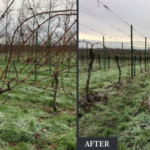
Winter pruning and water management

Although our vines are currently in their dormant phase, we have been busy in the vineyard starting our winter pruning. This is a huge task that is vital to ensure we have a good growing season and harvest, and it is all undertaken by hand whatever the weather. As 2026 so far has been very cold and then very wet, you can imagine how tough it has been! It is vital to get the pruning process completed before bud break or bud burst, which occurs in March to April.
We select two strong canes and one spur for the year (which is about the thickness of a pencil). We remove the rest of the unwanted canes with secateurs, ensuring these are sharp for clean cut. It is essential not to damage the vine as we do not want to reduce opportunities to produce canes in future years.
Then we trim the selected canes down so that between eight and ten buds remain on each. We tie down each of the remaining canes to the fixed fruiting wire, using eco-friendly, natural cane ties. With the two canes (now arms of the vine) tied down, we treat any large wounds with garlic paste. This acts as a barrier and prevents disease from entering the vine.
The majority of the grape varietals at Poulton Hill are pruned in this way, with the exception of our Pinot Noir vines. Pinot Noir is one of the more difficult varietals to grow in this part of the Cotswolds, so we prune each vine to a single arm to allow it to focus its energy. The single arm is trained uphill from the stem.
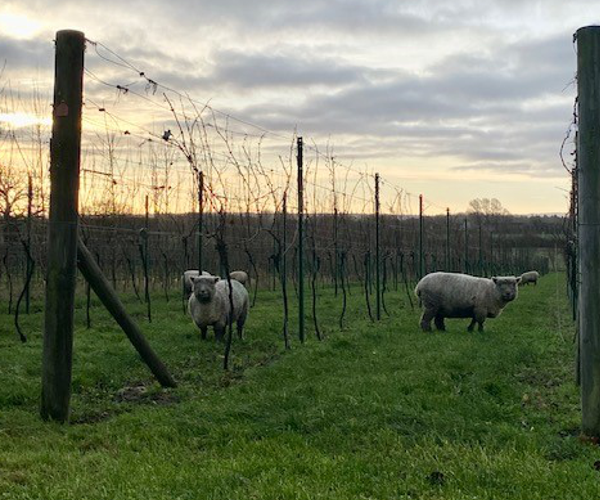
The wet weather has led to surface water on many of the fields around the area, but we have employed our secret weapon: sheep! Our flock of Babydoll and Black Jacob sheep are back in the vineyard, and their hooves help to break up compacted soil to improve the drainage. However, they also help the vineyard to be more biodynamic and reduce the need for chemical pesticides, weedkiller and fertiliser. They do a great job of nibbling the grass and weeds that spring up between the vines and help to fertilise the soil!
The sheep also like to assist our gardening team by nibbling on the roses that we plant at the end of each row of vines, which saves on pruning. Roses are traditionally planted in vineyards as an early warning system as they attract insects, such as aphids, and they develop fungal diseases, such as black rot and mildew, before they impact the vines.
Once the weather warms up and our vines start to come out of their dormant state, the sheep move to pastureland on the estate to protect the vines’ precious buds and leaves.
Add some local sparkle to your Valentine’s Day
St Valentine’s Day is coming up this month and if you are looking for a special treat for your loved one, we have a whole range of special wines and spirits, including our Bulari sparkling white and sparkling rosé wines. You can buy them as a gift in one of our special wooden gift boxes or serve with a romantic meal. Check out our wines in our online store or come to see us at the Cellar Door in Poulton, where you can buy our wine at special Cellar Door prices. We are open Tuesday to Friday 9am to 4pm and on Saturday from 11am to 3pm.